Problems we solve
- A promising AI prototype has no route to production
- Skilled staff spend hours on triage a system could handle
- Documents, tickets and transcripts hold answers nobody has time to extract
- An AI feature is live, but nobody can tell whether it is getting worse
Where this fits
- Manual, repetitive workflows eating your team's time
- An AI pilot that never made it past the demo
- Unstructured data — documents, tickets, calls — nobody has time to process
- Needing AI evaluated and monitored like the rest of production
What's included
- LLM application development
- AI agents & automation
- RAG & retrieval systems
- Model evaluation & monitoring
Technologies
Process
How we deliver it.
01
Scope the use case
We start from the workflow, not the model — identifying where automation actually removes work instead of adding a chatbot on top of it.
- Use case & data assessment
- Feasibility review
- Success metrics
02
Prototype
A working proof of concept against your real data, fast enough to know within weeks whether the approach holds up.
- Working prototype
- Evaluation dataset
- Go/no-go recommendation
03
Build for production
Retrieval pipelines, agents and guardrails engineered like any other production system — versioned, tested, and observable.
- Production AI pipeline
- Evaluation harness
- Human-in-the-loop review paths
04
Operate & improve
Model and prompt performance get tracked in production, not just at launch, so accuracy doesn't quietly drift.
- Usage & accuracy monitoring
- Continuous evaluation
- Iteration on real usage
Outcomes
What you have at the end.
Concrete artefacts and capabilities, not a status report.
Why Dopstack
What working with us looks like.
From the blog
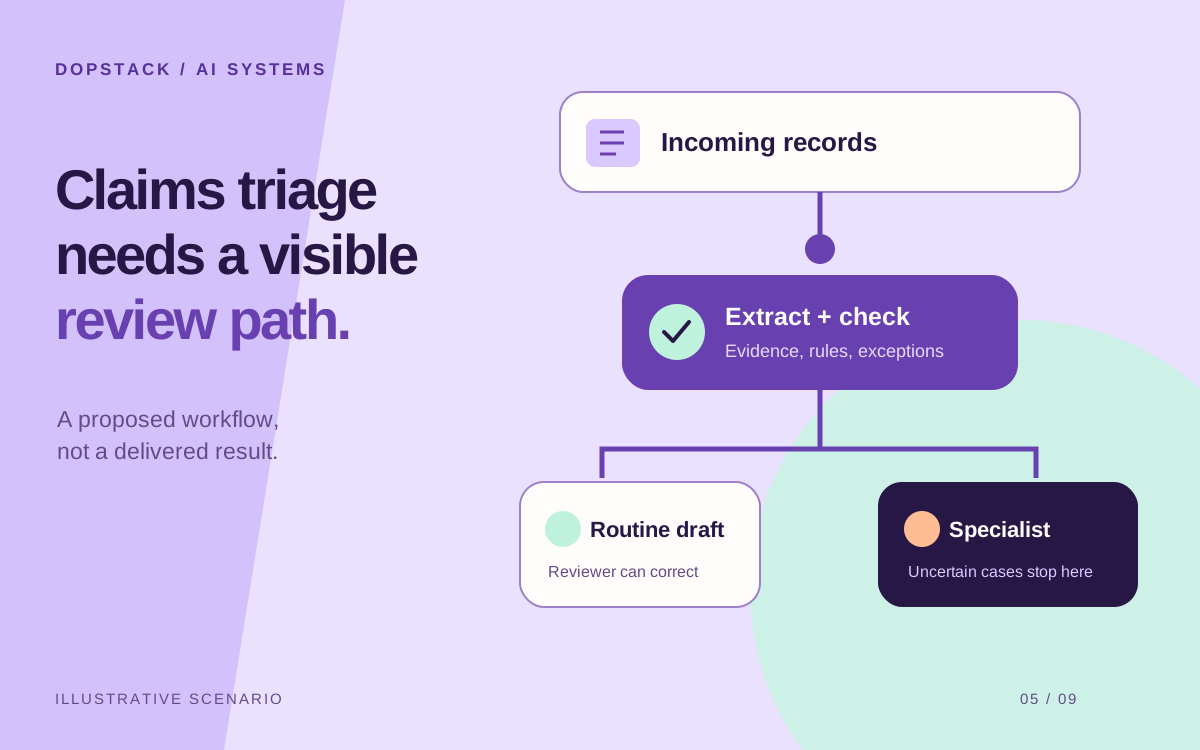
Explore a representative scenario.
Illustrative engineering scenarios, not published client projects.
FAQ
Questions we get asked.
What is the difference between an AI prototype and a production AI system?
A prototype proves an output is possible. A production system defines what happens when the model is wrong, runs an evaluation set on every change, enforces access control over the data it retrieves, and reports accuracy, latency and cost while it runs. The prototype is usually a small fraction of the work.
When is RAG the right approach, and when is it not?
Retrieval-augmented generation fits when answers have to be grounded in your own content and that content changes. It is the wrong tool when the task needs deterministic logic, when the source data is too inconsistent to retrieve reliably, or when a database query would answer the question outright.
Do we need to fine-tune a model?
Usually not first. Retrieval and prompt design solve most domain-knowledge problems at lower cost and are far easier to update. Fine-tuning earns its place for consistent format, tone or a narrow repeated task, once those cheaper options have been shown to fall short.
What do you mean by an AI agent?
A system that takes actions — calls tools, queries systems, updates records — rather than only returning text. That makes permissions, auditability and a defined stopping condition part of the engineering rather than optional extras.
How do you evaluate something non-deterministic?
With a labelled set representative of real inputs, scored on every change, plus the same metrics monitored in production. Non-deterministic does not mean unmeasurable; it means you measure distributions rather than single answers.
Which model providers do you work with?
We select per use case rather than by vendor. Our stated stack covers OpenAI and Anthropic models alongside open-weight options, and we design so the model can be swapped without rewriting the system around it.