Illustrative engineering scenario
This is a conceptual example of how we would approach a representative problem. It is not a published client project or a claim of delivered results.
The short version
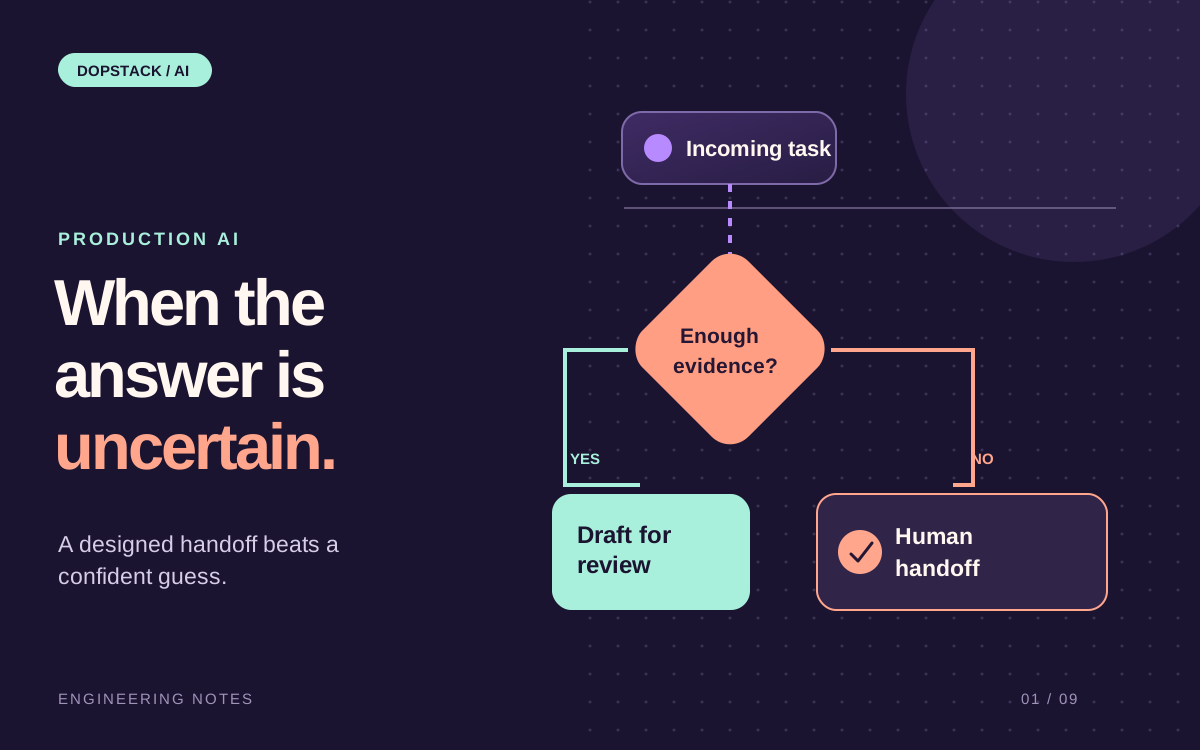
The key design question is what the workflow may decide, and what it must hand back to a person.
The decision in this scenario
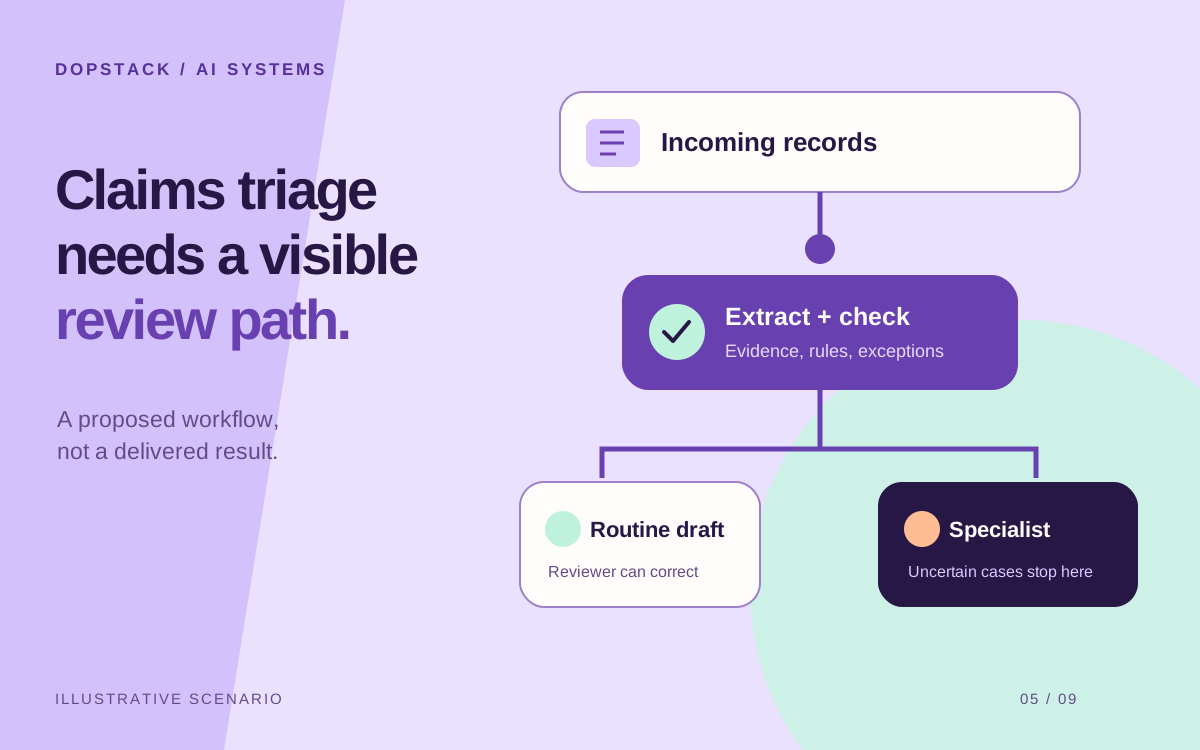
Imagine a claims team considering AI to extract details from incoming documents and suggest a review queue. A polished demo might show the happy path, but the real design question is what happens with a missing page, conflicting evidence or a case the system was not authorized to decide. This is a conceptual workflow, not a report of a client deployment.
A defensible starting approach
We would limit the first release to an intake draft: extracted fields, supporting document references and a suggested queue. Approval and payment would remain with authorized staff. NIST's AI framework emphasizes documented task scope, oversight and evaluation; those principles help frame the design but do not substitute for a claims-specific risk assessment.
Evidence: NIST: AI Risk Management Framework Core
Illustrative workflow
Route uncertainty to a reviewer.
Claim evidence
Controlled source documents
Extraction
Structured fields and anomalies
Stop rule
Measured or explicit escalation
Review
Specialist handles uncertain cases
Test evidence and routing separately
Build a held-out set with incomplete scans, duplicate documents, contradictory dates and out-of-scope requests. Check field accuracy, whether the cited document actually supports each field and whether the case reaches the right reviewer. A correct-looking JSON object is not enough if the system used the wrong source.
If an agent chooses tools, inspect that trajectory as well as the final response. Google Cloud documents these as separate evaluation targets. If a simpler extraction pipeline works, its smaller permission surface may be preferable to an autonomous agent.
Evidence: Google Cloud: Evaluate Gen AI agents · NIST: AI Risk Management Framework Core
Make escalation useful to the specialist
A reviewer should see the original record, extracted fields, reason for escalation and any conflicting evidence. Define who owns the queue and how a correction feeds back into evaluation. A hard stop for a missing required document can be safer than trusting a model's self-reported confidence.
The tradeoff is that human review limits how much work can be automated initially. That is acceptable if it makes mistakes observable and prevents the pilot from quietly making a financial decision it was not designed to make.
Evidence: NIST: AI Risk Management Framework Core
What the team would need to build and prove
- Access-controlled retrieval only if the task genuinely needs historical examples
- Structured extraction with document-level evidence references
- Explicit stop and specialist-review routes for missing or conflicting evidence
- Held-out evaluation run when prompts, models or tools change
- Monitoring for routing errors, reviewer corrections, latency and cost
What success would mean
Success would mean staff can use and correct intake drafts, exceptions reliably reach the right specialist and changes are evaluated before release. That is a proposed acceptance standard, not a claim of achieved accuracy or cost savings.
Technologies in this example
- Python
- OpenAI
- AWS
- PostgreSQL
Sources & further reading
- Google Cloud: Evaluate Gen AI agents
Documents final-response and trajectory evaluation; the claims examples are hypothetical.
- NIST: AI Risk Management Framework Core
Primary guidance on scope, oversight and measurement; not a validation of this design.
Written by Dopstack Technologies
We design and build software, cloud infrastructure and AI workflows. These notes explain engineering decisions; illustrative scenarios are not claims of client results.
Meet the team