The challenge
Moving companies lose hours on every quote. Details arrive by phone, form and email; someone pieces the job together; inventories and tariffs are copied between tools before a price can be checked. Quick descriptions miss items and access details, which leads to under-quoted jobs or a site visit for every enquiry.
The approach
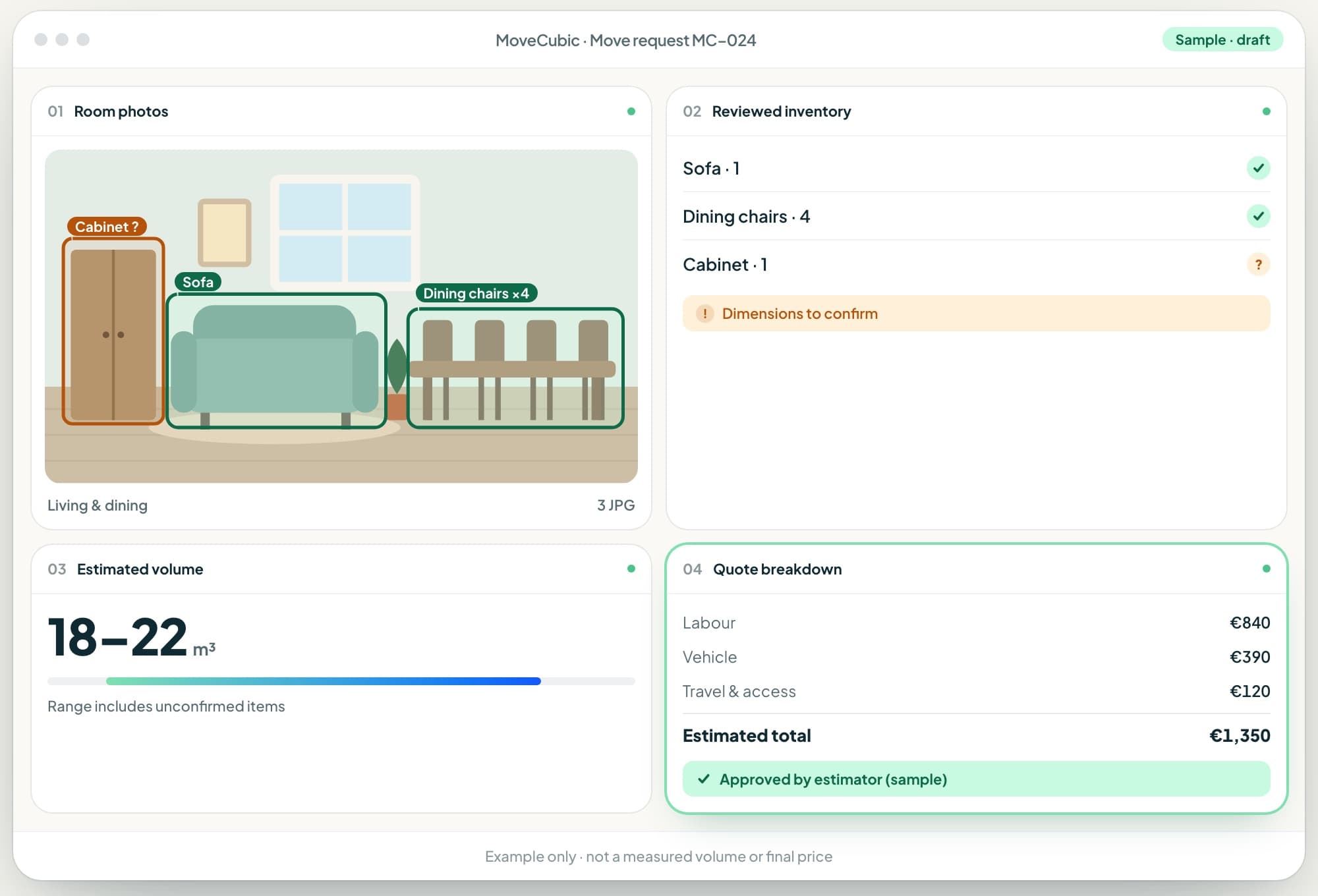
We designed MoveCubic around the estimator, not around the AI. Customers send room-by-room photos; the system proposes an inventory with source photos and uncertainty flags; confirmed items become a volume range; and the company's own versioned rate card produces a transparent draft price. Nothing is sent to a customer until an estimator approves it.
What gets built
- A TypeScript modular monolith: Next.js for the marketing site and tenant app, NestJS for the API and a separate background worker sharing one codebase.
- Multi-tenant data model in MySQL with Prisma, where every query is scoped by a server-derived tenant context and covered by cross-tenant regression tests.
- AI inventory extraction behind provider adapters, returning validated structured output with uncertainty flags; model, prompt version, latency and cost are recorded for every run.
- Pricing is a server-side formula on versioned rate cards using exact money arithmetic, so a later tariff change can never silently alter an accepted quote.
- Redis and BullMQ for background jobs, a transactional outbox for side effects, and idempotent jobs and webhooks so a retry never sends a quote twice.
- A bilingual (Dutch and English) marketing site with a server-validated pilot enquiry flow, built to WCAG basics and reduced-motion support.
Outcome
MoveCubic is in late development and launching soon with a founding pilot for Dutch moving companies. We will publish measured results, such as quote turnaround time and estimator correction rates, once pilot customers have used it on real jobs.
Engineering lesson
Automation earns trust when people can see and correct it. Showing source photos, ranges and open questions next to every suggestion did more for confidence than a more confident-looking answer would have.
Technologies