Copilot server auth preview: set the spending boundary
Assess Copilot server authentication in public preview. Plan organization billing, explicit tokens, runtime renewal and a bounded service pilot.
Quick answer
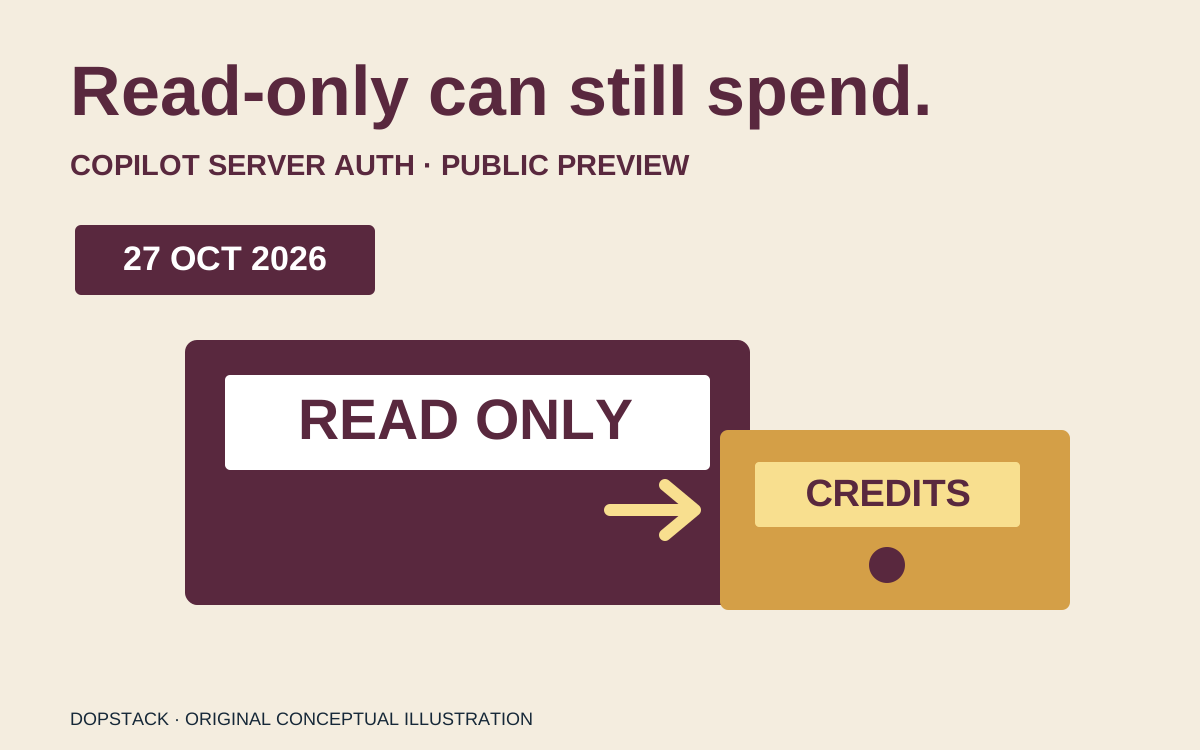
GitHub Copilot's server-to-server authentication public preview lets an organization-installed GitHub App make SDK requests without a signed-in user's credentials. Treat that identity change as a spending and runtime-lifecycle decision. The read-only Copilot Requests permission can consume organization credits, and GitHub does not offer an individual app budget for this authentication path. [1][2][3]
On this page
GitHub Copilot's server-to-server authentication public preview lets an organization-installed GitHub App make SDK requests without a signed-in user's credentials. Treat that identity change as a spending and runtime-lifecycle decision. The read-only Copilot Requests permission can consume organization credits, and GitHub does not offer an individual app budget for this authentication path. [1][2][3]
GitHub announced the preview on 27 October 2026. This is a dated analysis of that announcement and the documentation reviewed on 28 October, not a claim of general availability or a report from a live enterprise pilot. The useful question is what an engineering team should prove before replacing a person's credentials in an automated service. [1]
Scenario: a proposed repository-summary service currently depends on a developer's authenticated environment. The team wants an organization-owned identity, predictable attribution and a clear stop mechanism. Its pilot should establish those properties before increasing its workload. Merely obtaining a successful model response would leave most of the operational decision unanswered.
What changed on 27 October?#
The announcement introduces a workload identity for Copilot SDK requests through GitHub Apps installed on organizations. The app receives the organization-level Copilot Requests permission, uses a short-lived installation access token and attributes usage to the organization that owns the installation. That is the release's central change. [1]
It removes the need to tie this authentication path to a signed-in person. It does not remove the need to identify a service owner, control its inputs or decide what the agent may do with a response. Model access and repository permissions remain separate concerns. An app that can request a model does not thereby acquire every permission needed by its surrounding workflow. [3][5]
The administration documentation gives important limits: this path applies to organization installations, not personal-account or enterprise installations. It also describes Copilot Business and Copilot Enterprise administration. Confirm eligibility in the actual organization before designing a rollout around a preview feature. A broadly worded announcement is not evidence that a particular tenant is enabled. [3]
For the summary-service case, the proposed benefit is ownership continuity. A workload should not stop because a developer signs out or leaves the team. That is a design objective, not a measured reliability result from this preview. The pilot needs to show the intended identity is the one actually making and paying for requests.
Choose the identity before configuring the SDK#
Separate an external service from a GitHub Actions workflow. The SDK guide recommends an installation access token for a service acting for an organization, while its Actions section uses the built-in GITHUB_TOKEN with the Actions-specific permission and policy. The administration guide explicitly distinguishes these paths. Do not transfer a setting from one to the other without checking its scope. [2][3]
In particular, the external installation path does not require the “Allow use of Copilot CLI billed to the organization” policy. The SDK's Actions example does require that policy for its described flow. Those statements are compatible because they concern different authentication mechanisms. Record which path the service uses before diagnosing a policy error. [2][3]
GitHub App authentication itself has several identities: the app can authenticate as itself, as an installation or on behalf of a user. An app JWT used to mint an installation token is not the same credential as the token passed to Copilot. Keep those roles distinct in the architecture and secret inventory. [4][5]
For the proposed external summary service, the decision record selects an organization installation and an explicit SDK token option. The app's private key stays with the component authorized to mint installation tokens. The runtime receives only the credential it needs for the selected operation. This separation is our recommended design for the scenario, not a new requirement imposed by the announcement.
| Execution context | Documented identity path | Pilot evidence |
|---|---|---|
| External organization service | Organization installation access token | Correct installation and billed organization |
| Organization repository workflow | Built-in Actions token | Actions permission and applicable policy |
| User-driven application | User authorization where appropriate | User attribution and intended action scope |
The existing agent permission discussion remains relevant after changing authentication. A service identity needs an internal rule for which requests it will accept and which tools it will allow. Moving cost attribution to an organization does not make untrusted input safe or authorize an agent to act for every user.
What does a read-only permission let the app spend?#
It lets the app make requests that consume the organization's AI credits. GitHub's administration guide says the permission's read-only label does not mean the app cannot incur costs. Review it as permission to use a metered capability, not as a promise of financial harmlessness. [3]
Organization model policies and spending controls apply, but there is no budget for one app or installation in this path. An organization-wide alert also does not automatically stop spending. The administration guide distinguishes alerting from enabling the stop-usage behavior at the budget limit. Check the actual configuration before calling a pilot financially bounded. [1][3]
The missing per-app budget changes the pilot design. A shared organization identity provides ownership and attribution, but an app may need its own admission limits because the platform budget is broader than that app. Implement a bounded queue, concurrency control and a stop switch appropriate to the service. Treat those controls as application policy, not as a substitute for the organization's budget settings.
Write a small decision record before the pilot: who owns requests, which organization pays, which models are allowed, which input sources are admitted, what application limit stops new work, and who can suspend the installation. Add the condition that would invalidate the choice, such as a requirement for a provider-enforced independent app budget.
A forecast also needs a unit of work. For the summary service, define an accepted summary request and a completed result. Record failed and abandoned attempts separately. A response count alone cannot explain why cost grows when retries, long inputs or repeated polling increase. The cost-per-successful-task guide develops that accounting distinction.
Do not publish a cost estimate from the preview announcement alone. The sources establish who is billed and which controls apply; they do not supply your input distribution, model choice or retry behavior. Measure those in a bounded pilot and keep forecast assumptions separate from observed usage.
Plan token expiry as a runtime event#
Installation tokens expire after an hour. The SDK authentication guide says to mint a new token before expiry and restart the SDK client for a child-process runtime; it describes restarting the host runtime for an in-process or existing runtime connection. Token renewal therefore needs a lifecycle plan, not just a token-fetch helper. [2][4]
The documented child-runtime configuration passes the token explicitly and disables fallback to a logged-in user. The important subtlety is that disabling logged-in-user discovery also disables automatic environment-token discovery. Setting an environment variable without supplying the explicit option can leave the runtime unauthenticated. [2]
// Configuration fragment based on the reviewed SDK documentation.
// Pin and verify your installed SDK version before adapting it.
import { CopilotClient, RuntimeConnection } from '@github/copilot-sdk';

const token = process.env.INSTALLATION_TOKEN;
if (!token) throw new Error('INSTALLATION_TOKEN is required');

const client = new CopilotClient({
  connection: RuntimeConnection.forStdio(),
  gitHubToken: token,
  useLoggedInUser: false,
});
This is a configuration fragment, not a complete token service or a tested tenant integration. It does not show private-key storage, token minting, request handling or shutdown. Keep those responsibilities in named components rather than silently adding them to a client constructor.
For the illustrative service, stop admitting new work before a planned runtime replacement, finish or reconcile active jobs, start the replacement with a new token and resume admission only after an identity check. A long-running job needs a documented outcome if it crosses the credential boundary. Do not assume replacing an environment variable updates an already running process.
An authentication failure should remain distinguishable from a permission or model-policy failure. The SDK guide separates expired or invalid tokens, organizations not enabled for this path, missing Copilot Requests permission and unavailable models. Keep that distinction in diagnostics so an operator does not repeatedly mint tokens to repair a model-policy decision. [2]
The generic token guide also warns against assuming a fixed installation-token length as token formats evolve. Treat the token as an opaque credential. Record expiry and permission metadata from the minting response, and avoid parsing internal token structure to make authorization decisions. [4]
Keep the pilot's input scope narrow as well as its request rate. A repository-summary service can begin with an approved set of repositories and a reviewed output destination. Increasing model-request capacity should not implicitly increase repository access or the destinations that receive summaries. Review those changes as separate decisions, with the service owner retaining the record of what the app was intended to read and produce. [3][5]
What evidence should end the pilot?#
End it with an attribution and stop-control record, not just a demonstration prompt. GitHub says app attribution is available in CSV exports rather than the AI usage view. The guide maps app_client_id from usage rows to the installed app's client_id, with app_slug identifying the app. Preserve that join in the review evidence. [3]
An empty app-attribution field does not automatically prove the service failed. The documentation lists user-attributed usage, Actions, other GitHub-owned apps and historical usage among cases where the field is empty. Inspect the actual authentication path and reporting scope before drawing a conclusion from a blank field. [3]
For the proposed summary service, verify a small allowed request, a disallowed model, missing explicit-token configuration and token replacement. Rehearse the service's own stop switch in a nonproduction environment. Review how the organization would suspend or uninstall the app, including the effect on other resources accessed by the same installation.
Suspension or uninstallation is a real access-control action, not a harmless monitoring toggle. GitHub documents it as the way to stop an installation's requests and notes that it also blocks the installation's access to other organization resources. Keep the operational owner and rollback consequences in the plan before anyone needs the control during an incident. [3]
A small pilot can establish attribution without increasing the service's repository scope. It gives an external workload an identity whose cost can be attributed to an organization. Whether that identity is the right production choice depends on eligibility, lifecycle handling and the spending controls your team requires. Preview availability is a reason to test those boundaries carefully, not a reason to assume them away.
Frequently asked questions#
- Is server-to-server Copilot authentication generally available?
- The announcement reviewed for this analysis describes public preview, and the administration documentation says it is subject to change. The article is dated to the announcement and source review. Confirm the current documentation and your organization's eligibility before implementing the pilot. [1][3]
- Does read-only Copilot Requests avoid usage charges?
- No. GitHub explicitly states that this permission authorizes requests that consume organization AI credits. Review the app's purpose, request admission and organization spending settings. The read-only label describes the permission name; it does not establish a no-cost execution mode. [3]
- Can the organization set a budget only for this app?
- The reviewed administration guide says individual app or installation budgets are unavailable for this authentication path. Organization controls apply. If the service needs a narrower bound, define application admission limits and confirm whether that meets the team's financial control requirement. [3]
- Can I renew the token without considering runtime lifecycle?
- Do not assume that. The SDK guide describes minting before expiry and restarting the relevant client or host runtime with the new token. Test the lifecycle for your chosen connection mode, including active work and failure handling, before treating renewal as an unattended operation. [2]